

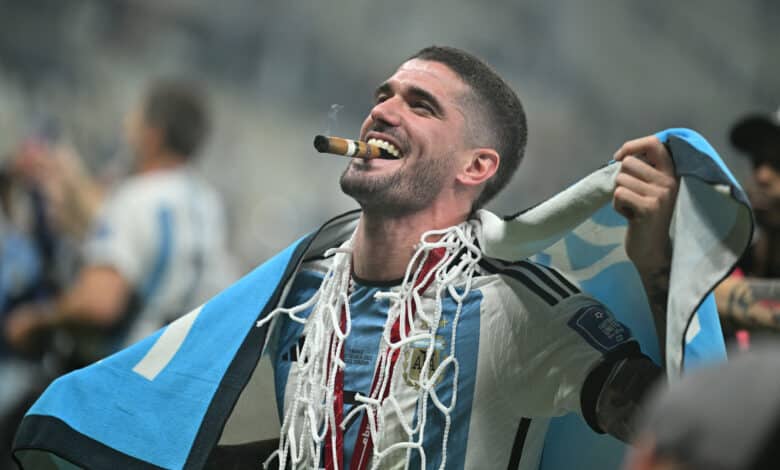
Argentina arrive in North America as reigning world and Copa América champions, trying to do something no team has managed since Brazil in 1962: win back‑to‑back World Cups. Models and expert previews put them firmly among the top contenders again, but not quite at the very top, which makes their defence as much about tactical resilience and tournament management as about raw star power.
How Strongly Are Argentina Rated Going Into 2026?
Quantitative models paint Argentina as one of the favourites, but not a runaway number one. Opta’s pre‑tournament supercomputer gave them roughly a 10–11% chance of winning the title, behind Spain and just behind or level with France and England in many simulations. Other modelling work, including a widely reported Goldman Sachs analysis, put their title probability closer to 14%, again in the same band as Spain and France.
Those numbers reflect two things at once: Argentina’s status as defending champions who topped South American qualifying with 38 points from 18 games, and the structural difficulty of repeating in a 48‑team tournament with an extra knockout round. For viewers, that means you should expect a deep run as a baseline—quarter‑finals or better are what the models consider “par”—but also recognise that the margin between success and failure is narrower now than it was in a 32‑team field.
What Does Argentina’s Current Game Model Look Like?
Under Lionel Scaloni, Argentina have built one of the most coherent tactical identities at international level, oscillating between a 4‑3‑3 and a 4‑4‑2 depending on game state and opponent. In possession, they create central overloads with Rodrigo De Paul, Enzo Fernández and Alexis Mac Allister, allowing Lionel Messi to roam into pockets between the lines while Lautaro Martínez and Julián Álvarez alternate between pinning the last line and dropping to connect.
Out of possession, the structure is deceptively simple: a narrow, hard‑working midfield three protects the centre, the wide players track full‑backs, and the back four—often Molina, Romero, Lisandro Martínez and Tagliafico—hold an aggressive line but rarely over‑commit both full‑backs at once. The result is that Argentina can press high in waves without being constantly exposed in transition, and when they do drop into a mid‑block, their distances remain compact enough to keep xG against relatively low across 90 minutes.
Early 2026 Signals: What Their Group J Start Tells Us
Argentina’s group‑stage route in 2026 is designed to be manageable. Drawn into Group J with Algeria, Austria and Jordan, they play all three matches in the United States, starting against Algeria and then facing Austria and Jordan at AT&T Stadium in Arlington. On paper, this gives them a gentle ramp into the tournament: limited travel, familiar conditions and opponents they are expected to dominate.
Their opening game offered exactly the kind of performance you want to see from a defending champion. Against Algeria in Kansas City, Argentina cruised to a 3‑0 win, with Messi scoring his first World Cup hat‑trick and becoming the first man to play in six World Cups. The pattern mattered as much as the score: sustained control, regular entries between the lines and a defensive shape that limited Algeria to low‑quality chances. For viewers, that is an early indication that the core Qatar template—controlled aggression plus Messi’s individual edge—has carried over rather than regressed.
Why Watching Argentina ดูบอลสด Reveals Their Real Ceiling
Seeing Argentina ดูบอลสด across full matches, rather than just highlight reels, is the best way to judge whether they can actually defend the title. Their system depends on details that only reveal themselves over 90 minutes: how Mac Allister and Fernández take up positions to recycle possession, how often De Paul drops into the back line to help progression, and how Messi chooses his pressing moments rather than sprinting in every phase. Live viewing lets you see when they throttle the tempo on purpose—using short passing spells to rest with the ดูบอลสดฟรี goaldaddy.—and when a drop in intensity is more about cumulative fatigue or pressure from the opponent.
Over a long tournament, tracking those shifts game by game is crucial. You might see a group match where Argentina sit a little deeper and counter more, and then a knockout tie where they push their line higher and pin a rival back. That flexibility is what gave them resilience in Qatar, and if you watch attentively this time, you can spot whether they still have the energy and clarity to change gear in the last half‑hour of tight matches—a key requirement if they are to negotiate eight games instead of seven.
Strengths That Support A Title Defence
From a performance‑trend perspective, several factors work in Argentina’s favour. First, their core group has stayed remarkably stable: Scaloni remains in charge, and many of the key players from 2022—Messi, De Paul, Martínez, Tagliafico, Romero, Mac Allister, Fernández—are still central. That continuity reduces the integration load; roles are known, automatisms are built, and younger additions can slot into a well‑established framework.
Second, their competitive form between World Cups has been strong. They dominated CONMEBOL qualifying, finishing top with 12 wins, two draws and four losses, and added further competitive experience in Copa América matches. Third, the Group J draw and U.S.‑based travel pattern protect them from some of the harshest early‑tournament conditions—altitude and extreme heat are more pronounced in Mexican and certain U.S. southern cities—allowing them to manage physical load in the opening phase. Together, those factors make it more realistic that they arrive in the latter rounds with their structure intact and key players relatively fresh.
Vulnerabilities And Historical Obstacles
Against that, history and context both impose real constraints. No team has defended a men’s World Cup title since Brazil in 1958 and 1962, meaning more than six decades of failed defences by great sides from Italy, Germany, Spain and France. The 2026 format is also less forgiving: 48 teams, a round of 32 and more travel raise the odds of variance—one bad day, one injury or one tactical mismatch causing an early exit.
Within the squad, age and dependence on Messi are the main tactical questions. Even with his hat‑trick against Algeria, he is operating at a different physical baseline to 2014 or even 2022, and Argentina’s ability to defend their title may hinge on how well others—Álvarez, Lautaro, emerging wide players—shoulder ball‑progression and final‑third creation when he conserves energy. If you notice in live games that Argentina struggle to create high‑quality chances when Messi drifts out of possession chains, that is a warning sign; if their structure generates xG reliably even on quieter Messi nights, their defence looks far more plausible.
How Their Path Through The Bracket Could Shape Their Chances
Projections that simulate the bracket highlight that Argentina’s likelihood of defending the title depends heavily on who they meet from the last 16 onwards. Opta’s model, for example, gives them roughly a 45% chance of reaching the quarter‑finals and around 30% of making the semi‑finals, with about 10–11% for winning it all. Those probabilities embed assumptions about likely opponents: a relatively favourable round‑of‑32 tie followed by a more even quarter‑final and elite semi‑final.
For live viewers, that context helps frame what you are seeing. A nervy performance against a strong quarter‑final opponent does not automatically mean Argentina’s level has dropped; it might simply reflect the fact that at this stage, they are finally facing another top‑tier structure. Conversely, if they labour badly in a round‑of‑32 game against a side that models rate much lower, that is a sign that fatigue, injuries or tactical predictability could derail the defence earlier than expected. Watching full matches with the bracket in mind lets you separate opponent quality from Argentina’s own trajectory.
Summary
Argentina’s attempt to defend their World Cup title in 2026 sits at the intersection of strong structural reasons for optimism and the hard mathematics of a bigger, longer tournament. Models place them firmly among the favourites but usually behind Spain and France, with roughly a one‑in‑ten shot of lifting the trophy again and a much higher probability of at least reaching the late knockout rounds. For viewers, the key is to watch how their familiar Scaloni framework—compact midfield, controlled aggression, Messi orchestrating the final third—holds up across eight potential matches and different conditions; if that structure continues to generate stable performances and others increasingly carry the creative load, Argentina have a genuine chance of achieving a title defence that has eluded every champion for more than 60 years.