

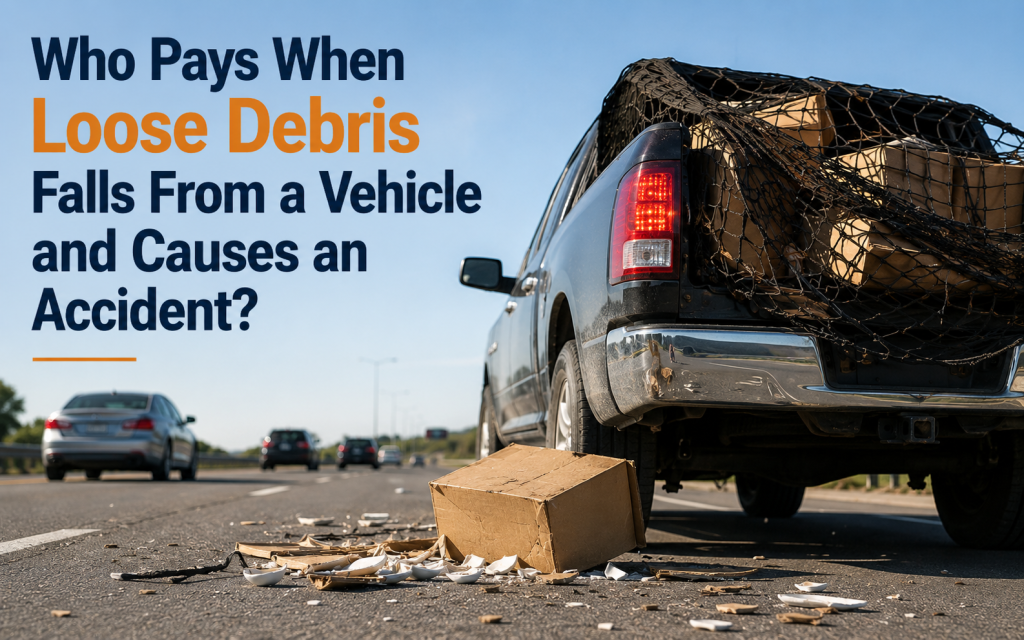
A ladder slides out of a pickup truck. A piece of furniture falls from a trailer. Construction material breaks loose from a commercial vehicle. Within seconds, nearby motorists may be struck by the object, forced into another lane or involved in a multi-vehicle collision while trying to avoid it.
When cargo or debris falls from a moving vehicle, the person or company responsible for securing the load may be held liable for the resulting injuries and property damage. In many cases, that begins with the driver who transported the unsecured cargo. Depending on the circumstances, the vehicle owner, trucking company, cargo-loading contractor or another business may also share responsibility.
Recovering compensation becomes more difficult when the responsible vehicle leaves the scene or cannot be identified. The injured person may then need to use their own collision, comprehensive, medical-payments or uninsured motorist coverage, depending on how the accident occurred and what the policy provides.
Because loose-debris cases often turn on identification and proof, motorists should gather as much evidence as possible without placing themselves in additional danger.
Quick Insights
- Drivers generally have a duty to reasonably secure objects carried in or on their vehicles.
- A driver may be liable when loose cargo falls from the vehicle and causes a direct impact or evasive-action collision.
- The driver’s liability insurance may pay for another person’s medical expenses, lost income and property damage.
- Commercial-truck cases may involve federal cargo-securement regulations.
- A trucking company, shipper or loading contractor may share responsibility for an improperly secured load.
- Dashcam footage, witness statements, photographs and identifying information can be critical.
- If the responsible vehicle cannot be found, the injured person may need to rely on their own insurance.
- Whether comprehensive or collision coverage applies often depends on whether the object struck the vehicle or was already lying in the roadway.
Insurance classifications and uninsured motorist rules vary by state and policy.
Drivers Are Responsible for Securing What They Carry
A person transporting furniture, tools, construction materials, appliances, landscaping debris or other property must take reasonable precautions to prevent it from falling, shifting, spilling or blowing onto the road.
Reasonable cargo securement may require:
- Straps, chains or tie-downs
- A closed tailgate
- Cargo nets
- Tarps or covers
- Proper trailer connections
- Correct weight distribution
- Periodic inspections during the trip
- Removal of loose material from the vehicle’s exterior
A driver who places an object in a pickup bed without securing it may be negligent even if the object appeared heavy enough to remain in place. Traffic movement, highway speeds, wind, turns, braking and road imperfections can cause unsecured property to shift unexpectedly.
Liability may exist whether the debris physically strikes another car or forces a motorist to swerve and crash.
For example, a driver may potentially be responsible when:
- A mattress falls from a roof rack and strikes a following vehicle.
- A ladder slides from a pickup and causes a motorcyclist to lose control.
- Lumber falls from a trailer and blocks a traffic lane.
- Gravel spills from a truck and damages nearby vehicles.
- Scrap metal breaks loose and causes drivers to collide while avoiding it.
- An unsecured appliance falls into the roadway and triggers a multi-car pileup.
The central question is whether the person responsible for the load used reasonable care under the circumstances.
Who Is Liable When Debris Falls From a Vehicle?
The driver who failed to secure the cargo is often the first potentially liable party, but they may not be the only one.
The Driver
A driver may be negligent for failing to inspect or secure a load before entering the road.
The driver may also be responsible for:
- Ignoring a loose strap or open tailgate
- Continuing to drive after cargo began shifting
- Failing to stop after another motorist warned of a problem
- Driving too fast for the type of load
- Making abrupt maneuvers with unstable cargo
- Failing to inspect the load during a long trip
- Leaving the scene after cargo caused an accident
A driver cannot necessarily avoid liability by claiming someone else originally loaded the vehicle. A person operating the vehicle may still have an obligation to check whether the load appears secure before and during transportation.
The Vehicle Owner
The owner may be responsible when a defective vehicle component contributed to the loss.
Examples could include:
- A broken tailgate latch
- Defective roof-rack hardware
- A damaged trailer hitch
- Worn tie-down anchor points
- An unsafe trailer
- Missing cargo-control equipment
An owner may also be liable for allowing another person to use a vehicle that was unsuitable for transporting the load.
The Driver’s Employer
When cargo falls from a vehicle being used for work, the driver’s employer may be responsible under principles governing employee negligence.
The employer may also have committed its own negligence by:
- Failing to train drivers
- Providing inadequate securement equipment
- Requiring an overloaded or unsafe trip
- Ignoring prior cargo incidents
- Failing to inspect company vehicles
- Encouraging employees to rush
- Using unsafe loading procedures
The company’s commercial auto liability policy may provide coverage for the accident.
A Trucking Company or Motor Carrier
Commercial motor carriers are responsible for operating vehicles safely and following applicable cargo-securement requirements.
A trucking company may be liable when it:
- Failed to establish proper loading procedures
- Used worn or insufficient tie-downs
- Did not inspect the cargo
- Allowed an improperly loaded truck onto the road
- Failed to train the driver
- Violated weight or securement requirements
- Ignored known safety problems
The trucking company and driver may share responsibility even when another business physically loaded the cargo.
A Cargo Loader or Shipping Company
Commercial freight is not always loaded by the truck driver or motor carrier. A warehouse, shipper, distribution center or third-party loading company may prepare the cargo.
A loading company may potentially be liable if it:
- Used an unsafe loading pattern
- Failed to distribute weight properly
- Used defective pallets
- Did not secure heavy items
- Concealed an unstable load
- Provided inaccurate weight information
- Loaded freight in a way the driver could not reasonably inspect
Determining responsibility may require reviewing contracts, bills of lading, loading records, surveillance video and testimony from the people involved.
A Trailer or Securement-Equipment Manufacturer
In some cases, the cargo was secured correctly but a defective strap, chain, latch, rack, trailer or hitch failed.
A manufacturer or seller may face a product-liability claim when defective equipment causes the load to separate from the vehicle.
Cargo Securement Violations in Commercial-Truck Accidents
Accidents involving loose cargo from commercial trucks may be governed by federal cargo-securement regulations in addition to state traffic and negligence laws.
The Federal Motor Carrier Safety Administration’s cargo-securement requirements are intended to reduce crashes caused by cargo shifting within or falling from commercial motor vehicles.
Federal rules generally require cargo transported by a commercial motor vehicle to be loaded and secured in a way that prevents it from leaking, spilling, blowing, shifting or falling from the vehicle. The requirements apply to many forms of freight and include commodity-specific rules for certain loads.
Importantly, cargo securement obligations are not limited to flatbed trucks or open trailers. FMCSA guidance states that commercial motor vehicles with enclosed cargo areas must also comply with applicable rules intended to prevent cargo from shifting or falling.
Depending on the load, compliance may involve:
- A sufficient number of tie-downs
- Tie-downs with adequate working-load limits
- Proper blocking and bracing
- Header boards or bulkheads
- Secure doors, gates and tailboards
- Correct anchor points
- Protection against strap abrasion
- Specialized systems for logs, vehicles, coils or heavy equipment
- Inspections before and during transportation
A cargo securement violation does not automatically decide every legal issue, but it can be important evidence that the driver or motor carrier failed to use required safety precautions.
What Types of Cargo Commonly Cause Roadway Debris Accidents?
Almost any improperly secured object can become dangerous at highway speed.
Common examples include:
- Ladders
- Mattresses
- Furniture
- Appliances
- Lumber
- Pipes
- Metal sheets
- Tools
- Landscaping equipment
- Tires
- Auto parts
- Gravel
- Sand
- Soil
- Scrap metal
- Trash
- Tree limbs
- Construction debris
- Shipping containers
- Pallets
- Machinery
- Vehicle components
Even relatively small objects can cause serious harm. A piece of metal may penetrate a windshield, while loose gravel can damage glass, obscure visibility or cause a motorcyclist to lose traction.
The driver responsible for the debris may be liable even if their own vehicle never makes physical contact with another vehicle.
What If You Swerved to Avoid the Debris?
A direct impact is not required to establish liability.
A motorist may react to falling cargo by braking, changing lanes or steering toward the shoulder. That evasive maneuver can lead to:
- A rollover
- A collision with a guardrail
- A sideswipe crash
- A rear-end collision
- A crash with another vehicle
- A motorcycle accident
- A pedestrian or bicycle collision
The person who failed to secure the load may still be responsible if the evasive response was reasonable and the loose debris caused the accident.
Insurers may nevertheless argue that the injured driver overreacted, was speeding, followed too closely or made an unsafe lane change. Evidence showing how suddenly the hazard appeared can therefore be especially important.
What Must Be Proven in a Loose-Debris Claim?
The precise elements vary by state, but an injured person generally needs to show:
A Duty to Secure the Load
The driver, owner, trucking company or loader had an obligation to use reasonable care in transporting the cargo.
A Failure to Use Reasonable Care
The responsible party failed to secure, inspect or transport the load safely.
Causation
The unsecured cargo caused the collision or forced a reasonable evasive maneuver that resulted in the accident.
Damages
The claimant suffered injuries, property damage, lost income or another compensable loss.
The case becomes much stronger when evidence directly connects the debris to an identifiable vehicle.
Why Identifying the Vehicle Matters
When the vehicle that lost the debris is identified, an injured person may be able to make a third-party liability claim against the driver’s or company’s insurer.
Useful identifying information includes:
- License plate number
- Company name
- Truck number
- Trailer number
- U.S. Department of Transportation number
- Vehicle description
- Driver description
- Direction of travel
- Time and location
- Logos or markings
- Photographs or video
A partial plate number combined with a vehicle description may still help investigators.
Commercial vehicles often display identifying information on the cab, trailer or rear doors. Photographs of these markings can help determine the motor carrier and its insurer.
No one should chase or confront a vehicle after a crash. Safety and medical needs come first.
What Evidence Can Prove Where the Debris Came From?
Loose-debris cases can become difficult when the responsible driver denies that the object came from their vehicle.
Potential evidence includes:
Dashcam Footage
Dashcam video may capture the object falling, the responsible vehicle’s license plate and the sequence of the accident.
Drivers should save the original file promptly. Many cameras automatically overwrite older recordings.
Traffic and Business Cameras
Video may be available from:
- Traffic-management systems
- Toll facilities
- Nearby businesses
- Gas stations
- Homes
- Warehouses
- Construction sites
- Other vehicles
Footage is often deleted on a short retention schedule, making quick preservation requests important.
Witness Statements
Another motorist may have seen the cargo fall or noticed that the load was unstable before the crash.
Obtain each witness’s:
- Name
- Phone number
- Email address
- Vehicle description
- Brief account of what they observed
Photographs
Photographs can document:
- The debris
- Matching cargo remaining on the other vehicle
- Broken straps or chains
- An open tailgate
- Damage to the claimant’s vehicle
- Skid marks
- The accident scene
- Company markings
Physical Evidence
The debris itself may contain:
- Shipping labels
- Serial numbers
- Company markings
- Identifying paint
- Broken securement equipment
- Product or manufacturer information
When safe and lawful, the object should be preserved or photographed before it is removed.
Police Records
A police report may document witness information, statements from the driver, citations and the officer’s observations.
Commercial Records
In a truck case, evidence may include:
- Bills of lading
- Weight tickets
- Dispatch records
- Driver inspection reports
- Cargo photographs
- Loading instructions
- Telematics data
- Electronic logging records
- Maintenance records
- Securement-equipment inspection records
- Warehouse surveillance video
These records can help identify who loaded the cargo and who was responsible for checking it.
What If the Driver Leaves the Scene?
A driver may not realize that an object fell from the vehicle. In other cases, the driver may know what happened but continue driving.
The accident should be reported to law enforcement as soon as possible. Provide every available detail, including:
- Vehicle type
- Color
- License plate
- Company markings
- Location
- Direction of travel
- Description of the fallen object
- Whether anyone was injured
Leaving the scene may violate state law, but the precise duties and penalties vary. A police investigation may help locate the driver through traffic cameras, witnesses or commercial carrier records.
Which Insurance Pays When the Driver Is Identified?
When the responsible driver or company can be identified, their liability insurance may cover third-party losses.
Property Damage Liability
Property damage liability may pay for:
- Vehicle repairs
- Replacement of a totaled vehicle
- Damaged personal property
- Towing
- Storage
- Reasonable rental transportation
Coverage is subject to the policy limit and applicable law.
Bodily Injury Liability
Bodily injury liability may compensate an injured person for:
- Medical expenses
- Lost wages
- Reduced earning ability
- Pain and suffering
- Disability
- Future medical care
- Other injury-related losses
Serious commercial-truck accidents may involve multiple insurance policies or layers of coverage.
What If the Responsible Vehicle Cannot Be Identified?
When there is no license plate, video, witness or other evidence identifying the vehicle, there may be no practical way to bring a liability claim against the person who lost the debris.
The injured person may then need to use their own auto insurance.
Potential coverages include:
Comprehensive Coverage
Comprehensive insurance generally covers certain non-collision losses, including damage caused by falling objects. Some insurers also treat an object that falls from or is projected by another vehicle as a comprehensive loss. Progressive, for example, identifies rocks or objects kicked up by or falling from vehicles among events that comprehensive coverage may cover.
This might apply when a loose object is airborne and strikes the insured vehicle.
Collision Coverage
Collision coverage generally pays for damage resulting from contact with another vehicle or object.
It may apply when:
- The debris is already lying in the road.
- The driver runs over the object.
- The driver swerves and strikes a guardrail.
- The evasive maneuver causes a collision with another vehicle.
- The vehicle overturns while avoiding the debris.
Insurance classifications can vary. Industry guidance notes that either comprehensive or collision coverage may apply to road-debris damage depending on how the incident occurred.
Uninsured Motorist Coverage
Some states or policies may allow uninsured motorist coverage to apply when an unidentified or hit-and-run vehicle causes an injury.
However, uninsured motorist claims involving loose debris can be disputed. Some jurisdictions require physical contact with the unidentified vehicle, while others may recognize contact with an object that came from it or may apply different evidentiary rules.
The policy and state law must be reviewed before assuming that coverage is available.
Medical Payments or Personal Injury Protection
Depending on the policy and state, medical payments coverage or personal injury protection may help pay immediate medical expenses regardless of fault.
Health Insurance
Health insurance may cover accident-related medical treatment, subject to deductibles, copayments and reimbursement rights.
Comprehensive or Collision: Which One Applies?
There is no universal answer.
A commonly used distinction is:
- Debris flies or falls directly onto the vehicle: The insurer may classify the damage as comprehensive.
- The insured vehicle strikes debris already in the road: The insurer may classify the damage as collision.
- The driver swerves and hits another object: Collision coverage will often be the relevant physical-damage coverage.
Comprehensive generally applies to non-collision events such as falling objects, while collision generally covers damage from striking a vehicle or object.
The insurer’s decision will depend on the policy language and the facts of the loss. Coverage usually requires payment of the applicable deductible.
Can an Insurance Company Blame the Injured Driver?
Yes. An insurer may argue that the injured motorist failed to react reasonably.
Possible allegations include:
- Following the cargo vehicle too closely
- Speeding
- Driving while distracted
- Making an unsafe lane change
- Failing to maintain control
- Driving too fast for visibility
- Failing to notice debris already in the roadway
- Overreacting to a small object
The responsible party may still be liable even if the injured motorist shares some fault. The effect of shared negligence depends on the state’s comparative- or contributory-fault rules.
Evidence concerning distance, speed, traffic, lighting and reaction time can help determine whether the motorist had a realistic opportunity to avoid the hazard.
What Should You Do After a Loose-Debris Accident?
Move to a Safe Location
Get out of active traffic when it is safe to do so. Turn on hazard lights and avoid standing near moving vehicles.
Call 911
Report injuries, blocked lanes and dangerous debris. Law enforcement or highway personnel may need to remove the object before another crash occurs.
Obtain Medical Attention
Seek prompt evaluation for injuries. Symptoms involving the head, neck, back and soft tissues may not be immediately apparent.
Record Identifying Information
Write down or photograph:
- License plates
- Company names
- Truck and trailer numbers
- Vehicle descriptions
- Driver descriptions
- USDOT numbers
- The time and location
Photograph the Scene
Document the debris, vehicle damage, roadway, traffic signs, tire marks and surrounding conditions.
Find Witnesses
Collect contact information before witnesses leave.
Preserve Video
Save dashcam footage and ask nearby businesses or property owners to preserve any relevant recordings.
Notify Your Insurer
Report the accident promptly, but avoid guessing about facts you did not observe. Ask which coverages may apply and whether the insurer needs to inspect the vehicle.
Preserve the Damaged Property
Do not discard vehicle parts, cargo fragments or other evidence before the claim has been investigated.
What Compensation May Be Available?
A person injured by loose or falling cargo may be able to recover compensation for:
- Emergency medical treatment
- Hospital expenses
- Surgery
- Rehabilitation
- Future medical care
- Lost wages
- Reduced earning capacity
- Vehicle repairs
- Replacement of a totaled vehicle
- Towing and storage
- Transportation expenses
- Pain and suffering
- Emotional distress
- Disability
- Disfigurement
- Loss of enjoyment of life
In fatal accidents, eligible family members or the estate may have a wrongful-death or survival claim under state law.
Loose-Debris Accidents Require Fast Investigation
When cargo falls from a vehicle, liability generally rests with the person or business whose failure to secure the load caused the hazard. The driver is often responsible, but a vehicle owner, employer, motor carrier, loader or equipment manufacturer may also share fault.
Commercial-truck cases deserve particular scrutiny because federal cargo-securement regulations may apply. Driver inspection records, bills of lading, loading videos and company safety procedures may reveal whether the load violated required standards.
The most immediate challenge is often identifying the responsible vehicle. Dashcam footage, photographs, witnesses and commercial markings can make the difference between a third-party liability claim and a claim limited to the injured person’s own insurance.
When the responsible vehicle cannot be located, comprehensive or collision coverage may pay for vehicle damage, depending on whether the debris struck the car or was already in the roadway. Other coverage, including uninsured motorist protection, may also apply in some circumstances.
Promptly preserving evidence gives investigators the best opportunity to determine where the debris originated, why it escaped and who should pay for the resulting harm.
This article provides general educational information and is not legal advice. Cargo-securement laws, insurance requirements, uninsured motorist rules and filing deadlines vary by state. Anyone injured in a loose-debris accident should consult a qualified attorney in the jurisdiction where the collision occurred.
