

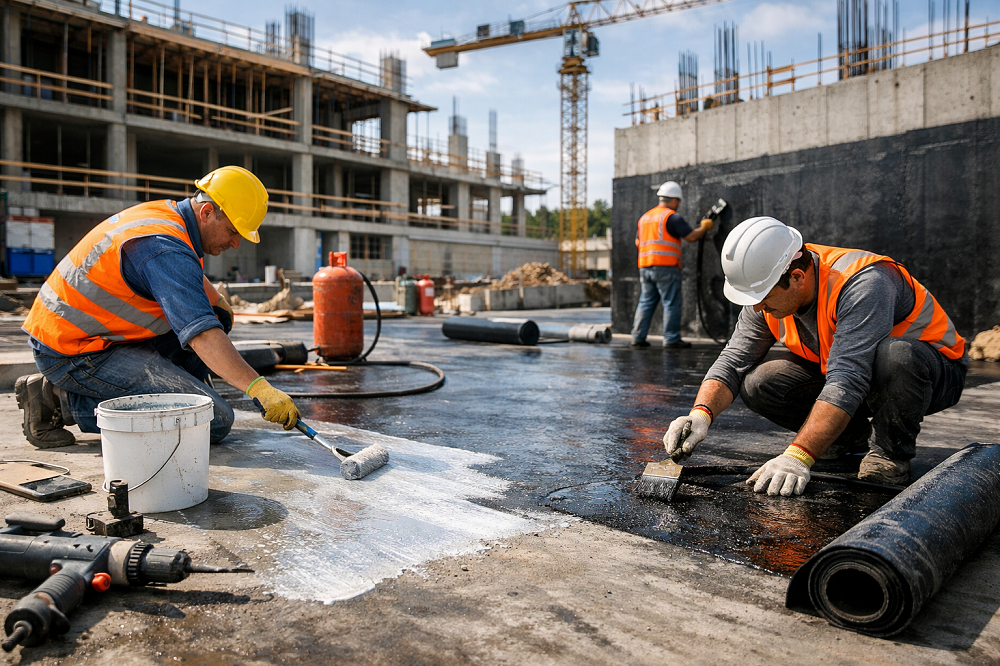
Walk through any major construction site in Dubai, Abu Dhabi, or Sharjah, and the visible work- the steel, the concrete, the cladding tells one story. The chemical systems applied behind and beneath all of it tell another. Admixtures in the concrete mix, waterproofing membranes on the below-grade structure, bonding agents at construction joints, repair mortars over damaged or deteriorated surfaces- these are the materials that determine how the structure performs over its actual service life rather than just how it looks at handover.
Why Construction Chemicals Matter More In The UAE Than Most Markets
Construction chemicals UAE projects rely on are doing a harder job than the same products would do in cooler, less aggressive environments. Chloride ingress from the coastal atmosphere accelerates steel reinforcement corrosion in ways that inland projects don’t face at the same rate. Sulphate attack on concrete is a documented issue in UAE soils and groundwater in certain areas. The intense UV exposure degrades polymer-based products that would last decades in northern Europe within a fraction of that time if they’re not specified for the conditions.
The consequence is that product selection in this market requires more specificity than a catalogue quote and a price comparison. A waterproofing membrane or a repair mortar that carries a European test certificate may or may not perform adequately in UAE conditions depending on what was tested, at what temperature, and against what exposure scenario. Suppliers who understand the local environment — who can point to projects in similar conditions and similar ages — are worth more than those who can only point to the datasheet.
Construction Chemicals Waterproofing: System Thinking Over Product Thinking
Construction chemicals waterproofing in the UAE context isn’t a single product decision; it’s a system decision. The membrane type, the primer, the detail treatment at penetrations and terminations, the protection layer, and the drainage management all contribute to whether the waterproofing system performs or fails. A high-quality membrane poorly terminated at a pipe penetration will fail at that point regardless of its quality elsewhere. A correctly specified membrane applied over a substrate that wasn’t adequately prepared will delaminate whether the product is expensive or not.
The failures that drive retrofits and litigation in UAE construction are rarely the middle of the sheet. They’re the details — the angles, the overlaps, the transitions between systems, the interfaces with other trades. Specifiers and contractors who treat waterproofing as a commodity product to be value-engineered tend to learn this the hard way. Those who treat it as a system where every component and every junction matters tend to have less to explain at defects liability reviews.
Concrete Repairs: The Work That Most Projects Defer Too Long
Concrete repairs in UAE structures tend to start as minor surface deterioration; carbonation, chloride-induced corrosion beginning to express itself as cracking or spalling, and become structural interventions if they’re left long enough. The chemistry of concrete deterioration in this environment is well understood. The gap between understanding it and acting on it early enough is where most repair budgets get inflated unnecessarily.
A repair system that works does several things simultaneously. It removes the deteriorated material back to sound concrete. It treats any exposed reinforcement to arrest the corrosion process. It reinstates the concrete with a mortar that is chemically compatible with the substrate, matches the carbonation resistance of the surrounding material, and bonds properly without creating a differential that causes the repair to act as a stress concentrator. Skipping any of these steps produces a repair that looks complete and fails within a few years, a pattern common enough in UAE maintenance programmes that it has its own informal name in the industry.
Selecting Products And Suppliers In A Crowded Market
The construction chemicals UAE market is well-supplied. Multinational chemical companies, regional manufacturers, and local distributors offer overlapping product ranges at a wide spread of price points. The challenge isn’t availability — it’s being able to distinguish between products that will perform in the conditions and products that are priced attractively because they were specified for somewhere else.
Technical support is the differentiator that matters most in practice. A supplier whose technical team will visit a site, assess the substrate condition, review the detailed drawings, and specify a complete system — rather than one who sends a price list and leaves the specification to the contractor — is providing something that affects project outcomes rather than just project costs. In a market where the consequences of getting construction chemicals wrong are expensive and sometimes irreversible, that support is worth factoring into the selection decision.
